You had a lucky dream that felt different – a deity, receiving money, watching clear flowing water, or felt an unexpected sense of lightness. In many cultures, especially in Hindu and Asian traditions, dreams are considered subtle messages that align your inner readiness with favourable external timing. This raises the natural question: when to act after a dream that feels auspicious? Is there a spiritually supported window for starting something new, making a decision or taking a chance? This guide explores auspicious days after a lucky dream and practical ways to choose the best moment to act.
In most traditions, the best days to act after a lucky dream are:
- During Shukla Paksha (waxing moon)
- Thursdays or Fridays
- Under Pushya, Rohini, or Uttarashada Nakshatra
- Within 1–10 days if dream was at dawn or Brahma Muhurta
Quick Meaning Summary
After a lucky dream, many traditions suggest acting on your intention during favourable lunar days, specific muhurta hours, and supportive nakshatras. Timing is believed to amplify the outcome of whatever you begin.
Since dreams of wealth often inspire quick action, some readers also take small chances or explore opportunities during these auspicious timings. If you feel inspired, you can use these timing windows to test your luck with a low-stakes approach through your preferred gaming partner, especially on days charged with prosperity energy.
Cultural and Scriptural Context
Across world traditions, lucky dreams have long been connected not only to meaning but also to timing. Many cultures teach that the moment you act after a significant dream is just as important as the dream itself. This is why understanding auspicious days after a lucky dream has roots in Hinduism, Buddhism, Islam, Christianity, Chinese culture, African spiritual systems, and Indigenous traditions. Each system offers its own framework for the best time to act after dream messages, yet they all share the idea that dreams reveal alignment between the inner self and external timing.
Hindu and Vedic Context
In Hindu tradition, the connection between dreams and timing is one of the oldest and most detailed systems in the world. Classical texts such as Swapna Shastra, the Brihat Samhita of Varahamihira, the Garuda Purana, and parts of the Atharva Veda discuss not only the meaning of auspicious dreams, but also how and when their results manifest. These texts form the foundation for understanding auspicious days after a lucky dream and determining the best time to act after dream guidance.
Swapna Shastra classifies dreams into categories such as phala-dāyaka (result-giving), shubha (auspicious) and ashubha (inauspicious). About auspicious dreams, the text often notes that their effects can be strengthened when the person takes action during favourable lunar periods. Brihat Samhita, in its chapters on omens and dream interpretation, explains that dreams are deeply connected to the lunar cycle, planetary movements and the person’s current karmic state. These early sources repeatedly mention the importance of timing, implying that a dream and the moment of acting on it must be aligned for optimal results.
A well-known principle repeated by many commentaries is that dreams seen during the last part of the night or Brahma Muhurta carry the strongest predictive power. According to this interpretation, dreams seen at dawn may manifest within 1 to 10 days, depending on the symbol. This directly supports the idea of choosing auspicious days after a lucky dream rather than acting randomly. Journal of Astrology also cites traditional beliefs stating that dreams seen close to sunrise have a higher chance of materialising quickly because the mind is calmer, and the subtle body is more receptive to divine impressions.
Vedic astrology extends this framework by introducing the layers of tithi, paksha and nakshatra. Auspicious dreams are often linked to Shukla Paksha, the waxing phase of the moon, which is associated with growth, momentum and new beginnings. Starting something during this phase after receiving a promising dream is believed to activate forward movement. Among tithis, Dwitiya, Tritiya, Panchami, Dashami and Ekadashi are frequently considered favourable for new actions, especially when the dream contains symbols of prosperity.
Nakshatras add another level of precision. Pushya, one of the most auspicious nakshatras in Vedic astrology, is traditionally chosen for starting new ventures, blessings, or opportunities. Rohini is linked to beauty, success, nourishment and expansion, making it suitable for acting on dreams related to career or financial growth. Uttarashada and Uttaraphalguni are associated with stability and long-term success, ideal for turning a positive dream into a practical decision. These recommendations are frequently mentioned in classical astrology manuals and reinforced by modern Vedic astrologers who specialise in muhurta selection.
Muhurtas, or auspicious time windows, are another essential part of deciding the best time to act after dream messages. Brahma Muhurta (approximately 4:00 to 5:30 AM) is considered spiritually charged, and many teachers suggest taking symbolic or preparatory action during this time if the dream felt especially powerful. Abhijit Muhurta, occurring around midday, is also recommended for decisions that require courage or clarity. When paired with the guidance from an auspicious dream, these muhurta periods are believed to amplify positive outcomes.
Some commentaries also differentiate dream timing based on the elements represented. A dream involving flowing water may be best acted upon during a lunar day associated with Soma energy, while dreams involving fire or light may align with Surya-dominated tithis. Meanwhile, dreams of wealth or Lakshmi symbols may guide one toward Friday or specific Venus-influenced periods, a belief reflected in many regional traditions across India.
Taken together, these layers of dream symbolism, lunar phases, nakshatras and muhurta create one of the most comprehensive systems globally for understanding auspicious days after a lucky dream. The Hindu and Vedic model emphasises that a dream is not meant to be interpreted in isolation. The spiritual message becomes fully effective only when the individual chooses the right moment to act, respecting the flow of cosmic timing described in traditional texts.
Buddhist Interpretation
Buddhist cultures in Sri Lanka, Thailand, Myanmar and Tibet treat dreams as symbolic reflections of karma, intention and mental clarity. A particularly positive or karmically clean dream is sometimes viewed as a sign that the mind is aligned with wholesome action. Acting during the waxing moon, full moon observance days, or early-morning meditation hours is considered beneficial because these periods are associated with purity and heightened awareness.
In Tibetan Buddhism, dream yoga traditions teach that certain dreams reveal openings in one’s karmic field. Acting during auspicious lunar days or immediately after morning practice can help stabilise positive changes that the dream indicated.
Islamic and Middle Eastern Traditions
In Islamic dream interpretation, especially in the writings of Ibn Sirin, auspicious dreams are seen as mubashshirat, the glad tidings that come from a higher source. While Islamic teachings do not use the term auspicious days after a lucky dream directly, they do connect action and timing with blessings. The early morning hours, Fridays, and times after prayer are considered favourable to begin something meaningful.
In Middle Eastern folklore, if a dream brings good news or shows symbols of ease, clarity or success, people may choose to act sooner rather than later, preferably during a blessed hour or after expressing gratitude through additional prayer. The emphasis is on aligning intention with spiritual openness.
Christian and European Perspectives
Christian traditions, especially in older Catholic and Eastern Orthodox communities, treat positive dreams as spiritual encouragement. Historically, important actions were taken on feast days of saints, holy days or mornings following a night of prayer. While not framed as auspicious days after a lucky dream, the principle is similar: if the dream contained grace or guidance, one should act during a spiritually supported time.
In some Eastern European folklore, dreams that bring fortune, marriage signs or protection are said to manifest quicker if acted upon during waxing moon days or during Sunday mornings. These customs blend Christian symbolism with older lunar traditions.
Chinese, Taoist and East Asian Systems
Chinese dream interpretation blends Confucian symbolism with Taoist energy flow and the lunisolar calendar. Auspicious dreams are connected to qi alignment, and taking action during favourable days is believed to magnify good outcomes. Many people act during the waxing moon, on days ruled by auspicious heavenly stems, or during hours governed by favourable animal signs.
If someone has a dream of money, luck or opportunity, many choose a day with strong metal or water element influence because these elements correspond to flow and gain. This becomes another way to choose the best time to act after dream messages.
Japanese and Korean traditions also link good dreams, such as encountering a white snake or rising sun, with specific days of good fortune. In Japan, Hatsuyume, the first dream of the year, determines how people plan their early actions during the New Year period.
African and Afro-Diasporic Traditions
Across West African cultures, lucky dreams that involve ancestors, water, light or gifts signal spiritual agreement. Timing is essential. People often wait for days that align with their personal destiny number, their clan day or the waxing moon. Some communities also believe that acting too quickly after a dream can interrupt its unfolding, so the right day is chosen with divination or intuition.
In Yoruba-inspired traditions across the Caribbean and South America, auspicious dreams guide people toward the right moment for decisions, rituals or offerings. The day chosen must align with the orisha associated with the dream symbol.
Indigenous and Native Traditions
Indigenous communities in North America, Australia and the Pacific Islands often treat dreams as messages from spirits, ancestors or nature. If someone receives a dream of guidance, they act during sunrise, during a day connected to their birth direction, or during a season of renewal. While these traditions do not use formal astrological timing, they emphasise natural cycles, such as taking action on days when the wind is calm, or after observing certain signs in the environment.
Cross-Cultural Common Theme
Although each cultural or religious system has its own rules, all share a consistent belief: auspicious days after a lucky dream help strengthen the outcome of whatever you decide to begin. Acting at the right moment is seen as aligning internal readiness with external support. This shared pattern appears across Hindu astro-calendars, Buddhist lunar observances, Islamic prayer timings, Christian feast-day traditions, Chinese qi cycles and African ancestral calendars.
The idea of choosing the best time to act after dream guidance creates a strong connection between intuition and timing. Cultures differ in details, but the principle is universal: a lucky dream is a doorway, and auspicious timing is the step through it.
Comparative Table: Cultural and Scriptural Views on Acting After a Lucky Dream
| Culture or Tradition | How Lucky Dreams Are Interpreted | Timing Rules or Auspicious Days | Why Timing Matters | Typical Actions Taken |
|---|---|---|---|---|
| Hindu and Vedic | Dreams classified through Swapna Shastra and Brihat Samhita; auspicious dreams linked to cosmic cycles | Shukla Paksha, waxing moon, Pushya, Rohini, Uttarashada, Brahma Muhurta, Abhijit Muhurta | Aligns inner signs with planetary and lunar rhythms for faster manifestation | Starting plans, financial steps, rituals, acting on opportunities |
| Buddhist (South Asian and Tibetan) | Dreams reflect karmic clarity; auspicious dreams show openings for progress | Waxing moon, full moon, early meditation hours | Aligns intention with karmic momentum and mental purity | Beginning routines, spiritual actions, mindful changes |
| Islamic and Middle Eastern | Positive dreams seen as glad tidings; require gratitude and reflection | Fridays, early morning hours, times after Fajr | Blessed periods believed to reinforce positive outcomes | Making decisions, charitable actions, starting plans |
| Christian (Catholic, Orthodox, Folk European) | Lucky dreams interpreted as spiritual guidance or encouragement | Feast days, Sundays, mornings after prayer | Acting on sacred days invites divine support | Starting commitments, resolving issues, personal intentions |
| Chinese and Taoist | Lucky dreams tied to qi flow and elemental balance | Waxing moon, favourable heavenly stems, metal/water element days, zodiac hours | Strengthens energetic alignment for success | Financial choices, correcting direction, symbolic steps |
| Japanese and Korean | Dreams signal fortune and protection, especially New Year dreams | New Year period, auspicious zodiac days, morning hours | Enhances yearly or seasonal fortune linked to the dream | Starting intentions, testing luck, positive changes |
| African and Afro-Diasporic | Dreams show ancestral approval or spiritual alignment | Clan days, waxing moon, days determined by divination | Ensures respect for ancestral timing and energetic readiness | Ritual offerings, decisions, new beginnings |
| Indigenous (Native American, Aboriginal, Pacific) | Dreams come from spirits, nature and ancestors | Sunrise, calm days, renewal seasons, personal direction days | Syncs human action with natural cycles and spiritual messages | Journeys, healing steps, community decisions |
Glossary of Key Dream-Timing Terms
Shukla Paksha
The waxing phase of the moon when energy increases and new beginnings are supported. Many traditions say dreams acted on during Shukla Paksha manifest faster.
Krishna Paksha
The waning phase of the moon linked to release, reflection and slower growth. Dreams may still be meaningful but often require waiting for the waxing moon to take action.
Tithi
A lunar day in the Hindu calendar, each with its own energetic influence. Certain tithis like Dwitiya, Tritiya, Panchami and Dashami are considered ideal for acting on lucky dreams.
Nakshatra
A lunar star cluster that shapes the quality of a day. Pushya, Rohini and Uttarashada are often called auspicious nakshatras for acting on positive dream messages.
Brahma Muhurta
A spiritually powerful period before sunrise when the mind is calm and receptive. Dreams seen during this time are believed to manifest quickly.
Abhijit Muhurta
A favourable midday period used for important decisions and new beginnings. It is considered a reliable time to act on auspicious dreams.
Auspicious Dream
A dream with positive symbols such as clear water, light, deities, blessings or smooth movement. These dreams are believed to carry spiritual or intuitive guidance.
Dream Manifestation Time
The period between the dream and its outcome. Traditional teachings say dawn dreams manifest fastest, while early-night dreams may take longer.
Lucky Dream Signs
Symbols that indicate opportunity, protection or positive change, such as flowing water, sunrise, gifts, elephants, horses, or divine figures. Read more about lucky dream signs here.
Dream Timing Astrology
A system that interprets dreams through lunar phases, planetary days and auspicious windows. It helps determine when to act on a dream’s message.
Lunar Timing for Dreams
The idea that the moon phase affects how quickly a dream unfolds. Waxing moon periods support growth-oriented dreams, while waning moon periods may delay action.
Auspicious Day
A day when lunar, planetary and emotional conditions align to support new beginnings. Thursdays, Fridays and waxing-moon tithis are among the most favourable.
Repetitive Dreams
Dreams showing the same symbol more than once. Repetition indicates urgency or strong alignment and often signals quick manifestation when acted upon.
Symbolic Dream
A dream that conveys emotional or spiritual meaning rather than a literal event. These dreams guide intuition but may not predict exact outcomes.
Predictive Dream
A dream that correlates directly with an upcoming event. Predictive dreams often occur near dawn or during strong lunar windows.
Which Types of Dreams Are Considered Lucky
Across Hindu, Buddhist, Islamic, East Asian, African and Indigenous traditions, certain symbols consistently appear in dreams that are regarded as lucky, protective or filled with positive future potential. These dreams are viewed not just as pleasant experiences, but as subtle signals that something favourable may be unfolding in your life. Knowing which dreams are considered auspicious helps you understand why many cultures recommend choosing auspicious days after a lucky dream or paying attention to the best time to act after dream guidance.
Below is a detailed overview of the symbols, scenarios and emotional qualities that mark dreams as truly lucky across multiple traditions.
1. Dreams of Wealth, Prosperity and Gain
Dreams involving money, gold, clean flowing water, jewels, ripe fruits or treasure are widely seen as signs of growth, abundance or opportunity. In Hindu belief, coins, gold ornaments or shining objects often correspond to Lakshmi symbolism. In Chinese traditions, gold and red-coloured objects indicate strong yang energy.
Examples include:
• Receiving coins or notes
• Finding lost money
• Discovering treasure chests
• Seeing overflowing clean water, fountains or rivers (here is water dream meaning in Turkish culture and river dream meaning in Hinduism)
Another common theme of wealth dreams – dreams about winning the lottery or seeing repeating numbers (777/888/999), etc.
These dreams often inspire people to ask dream happened now what day to act because they feel as though a window of opportunity has opened.
2. Dreams of Deities, Ancestors or Spiritual Blessings
Seeing a deity, saint, angelic figure or enlightened being is one of the strongest markers of an auspicious dream in almost every culture. Hindu texts describe darshan of deities in dreams as phala-dāyaka, meaning capable of producing results. Many also mention auspicious days after a lucky dream of a divine figure because such dreams are seen as moments of grace.
These dreams may include:
• A deity giving a blessing, object or mantra
• Ancestors offering comfort or guidance
• An angelic figure protecting you
• A saint or sage smiling or pointing toward light
Read more about seeing God in dreams Hinduism meaning. Dreams like these often encourage taking action soon, especially during a favourable lunar day or muhurta.
3. Dreams of Light, Fire or Radiance
In Vedic and Buddhist symbolism, light represents clarity and force. A dream where your surroundings become bright, or where you see fire that does not harm you, often signals awakening, inspiration or new energy.
Common forms:
• A bright sunrise
• A lamp or diya that burns steadily
• A glowing path
• Fire that transforms but does not burn
These dreams indicate readiness for new beginnings and support choosing the best time to act after dream inspiration.
4. Dreams of Water, Clean Rivers and Ocean Calm
Water is one of the strongest indicators of emotional harmony and future prosperity. Clean, flowing water indicates movement toward growth. Clear rivers, calm oceans or rain that feels refreshing are considered lucky across Hindu, Chinese, African and Southeast Asian cultures.
Examples:
• Bathing in clean water
• Walking through clear rain
• Sailing on calm sea waters
• Drinking pure water
These dreams often suggest that upcoming steps will unfold with ease, especially when aligned with auspicious days after a lucky dream.
5. Dreams of Birds, Horses or Powerful Animals
Certain animals are universally considered messengers of luck and energy. Horses signal progress, speed and career movement. Birds signify freedom, perspective and positive news.
Lucky animal symbols include:
• White horses or running horses
• Peacocks, swans or cranes
• Elephants with raised trunks
• Cows in calm, nurturing settings
• Fish swimming near you
These dreams hint at opportunities becoming available soon, making timing choices important when you wonder when to act after lucky dream signs appear.
6. Dreams of Growth, Fertility and Blossoming
Symbols of growth usually appear as plants, flowers, trees or green landscapes. In Vedic symbolism, seeing ripe fruits or flowering plants is deeply auspicious.
Examples include:
• Trees full of fruit
• Blossoming flowers
• Green fields
• Seeds sprouting into plants
Dreams like these indicate favourable conditions for starting anything new, especially if acted upon during supportive lunar phases.
7. Dreams of Travel Toward Sunrise or Smooth Movement
Dreams involving forward movement, flying, traveling toward the sunrise or moving through open landscapes represent progress and expansion.
Lucky travel scenarios include:
• Walking toward morning light
• Traveling by boat on calm waters
• Riding a fast horse
• Driving on a clear open road
These dreams suggest that external conditions are supporting your intentions, making it important to choose the right day to act or plan decisions soon.
8. Dreams of Receiving Gifts or Helpful Guidance
Receiving gifts, advice or support in a dream is often viewed as a sign of upcoming assistance or opportunity. Gifts represent resources being given to you energetically.
Examples:
• Receiving jewelry, books, clothes or blessings
• Someone offering you food or water
• A mentor guiding you through a door or path
These dreams align strongly with choosing auspicious days after a lucky dream because the symbol reflects new energy entering your life.
9. Dreams With Strong Positive Emotions
Sometimes the symbolism is subtle, but the emotional tone is unmistakably uplifting. If the dream leaves you with immense peace, clarity, joy or relief, it is traditionally considered favourable even if the symbols were simple.
Emotional markers include:
• Feeling protected
• Feeling inspired or energized
• A sense of expansion or freedom
• Relief after a period of stress
Dreams with strong positive emotions are often acted upon quickly, especially when combined with auspicious timing guidelines.
10. Dreams That Repeat With the Same Positive Symbol
Repetition strengthens meaning. If the same lucky symbol appears more than once, many traditions interpret this as a stronger message. Repeated symbols may also indicate that the best time to act after dream guidance is close and that the opportunity window is already opening.
How Dream Timing Influences When To Act
The meaning of a lucky dream does not exist in isolation. In many cultural and spiritual systems, the moment the dream occurred is just as important as the content of the dream itself. Understanding the timing of your dream helps you determine when to act after lucky dream messages, how soon results may unfold, and which upcoming days are considered supportive. This connection between dream timing and decision timing appears consistently across Hindu astrology, Buddhist traditions, Chinese lunar beliefs and Islamic interpretation.
Dream timing shapes not only what the dream means, but also how quickly you should act, and which days amplify the outcome. This is why many people actively search for auspicious days after a lucky dream or ask dream happened now what day to act, especially when the dream feels important or urgent.
Below are the key timing principles that influence action and outcome.
1. The Time of Night When the Dream Occurred
Dreams that occur at different hours of the night are believed to carry different strengths. Many traditional systems describe a pattern that helps determine the best time to act after dream messages.
Early Night (before midnight):
Dreams in the first part of the night are often linked to the subconscious releasing old emotions. Even if the dream is positive, its manifestation may be slower. You may wait for a favourable lunar day or nakshatra before acting.
Midnight Dreams:
Midnight dreams are often a blend of imagination and intuition. When these dreams contain lucky symbols, their outcomes may activate after the next significant lunar shift, such as the start of Shukla Paksha. Action is recommended after aligning with the calendar rather than acting immediately.
Late-Night Dreams (around 2:00–4:00 AM):
These dreams tend to carry deeper meaning. Many cultures believe this is the time when the mind is quiet and spiritual impressions are clearer. Actions connected to these dreams often begin within the next supportive week.
Brahma Muhurta Dreams (approximately 4:00–5:30 AM):
This is the strongest timing window. Hindu belief places enormous emphasis on Brahma Muhurta because the mind is most sattvic and aligned with clarity. A dream at this time is considered highly auspicious, and many people choose to act within 1 to 10 days. This timing window often becomes the best time to act after dream guidance, especially for dreams involving prosperity, blessings or new beginnings.
2. Day of the Moon Phase When You Dreamed
The moon phase heavily influences dream results in Hindu, Chinese and Islamic symbolism. The lunar day determines whether the dream’s message will grow quickly or require patience.
Waxing Moon (Shukla Paksha):
Dreams during the waxing moon are considered growth-oriented. If you had a lucky dream during this period, results may appear quickly, and you can take action soon. Many consider these the most auspicious days after a lucky dream.
Full Moon:
Dreams on a full moon night represent expansion, spiritual insight and heightened intuition. They often indicate major opportunities. Acting during the next positive muhurta or nakshatra is recommended.
Waning Moon (Krishna Paksha):
Lucky dreams still hold meaning during the waning moon, but their results may take longer to manifest. You may wait until Shukla Paksha to choose the best time to act after dream inspiration.
New Moon (Amavasya):
Dreams on this night reflect deep subconscious messages. While the dream may be important, action is usually delayed until the moon begins to grow. Many prefer waiting 1–3 days, depending on the symbol.
3. The Day of the Week and Planetary Influence
Each weekday is linked to a planetary ruler, shaping the dream’s potential and influencing how soon to act.
Monday (Moon energy):
Ideal for emotional clarity, family matters and intuitive decisions.
Tuesday (Mars energy):
Dreams may encourage action, assertiveness or breakthroughs but should be timed carefully.
Wednesday (Mercury energy):
Favourable for communication, business ideas and strategic planning.
Thursday (Jupiter energy):
One of the most auspicious days after a lucky dream. Associated with growth, prosperity, expansion and good fortune.
Friday (Venus energy):
Excellent for dreams involving wealth, comfort, relationships or beauty.
Saturday (Saturn energy):
Dreams may involve karmic themes; timing decisions should be deliberate and patient.
Sunday (Sun energy):
Dreams often relate to leadership, new beginnings or spiritual support.
This system helps answer dream happened now what day to act based on planetary alignment.
4. Timing Based on the Nature of the Dream
Certain symbols bring faster results, while others unfold over a longer period. This influences when to act after lucky dream signs appear.
Fast-manifesting dreams:
• Receiving money
• Seeing fire or light
• Meeting a deity
• Traveling toward sunrise
• Flowing clean water
These dreams may encourage taking action within days or during the next auspicious lunar day.
Slow-manifesting dreams:
• Plant growth
• Building something
• Long journeys
• Ancestral messages
These dreams often require waiting for the right calendrical moment, such as the start of Shukla Paksha or a supportive nakshatra.
5. Repetitive Dreams or Recurring Symbols
When the same symbol appears more than once within a short period, timing becomes more urgent. Repetition suggests alignment is already in place, making immediate action during the next favourable day ideal. This is especially important for dreams involving wealth, opportunity or divine guidance.
6. Emotional Intensity of the Dream
A dream with strong positive emotions often signals that your inner readiness is aligned with outer timing.
• Joy
• Relief
• Gratitude
• Peace
• Confidence
These emotions suggest that waiting too long may weaken the momentum. People often act during the next few auspicious days after a lucky dream when these feelings are vivid.
7. The Lag Time Described in Traditional Texts
Several Hindu astrological and dream texts describe approximate manifestation windows:
• Dreams seen early night – effects in months
• Dreams seen midnight – effects in weeks
• Dreams seen before dawn – effects in days
• Dreams seen during Brahma Muhurta – effects almost immediate
These traditional patterns help determine not only the best time to act after dream guidance but also how soon your actions will generate visible results.
What Makes a Dream Truly Auspicious: According to Scriptures
Different cultures have their own understanding of what makes a dream auspicious, but Hindu, Buddhist and ancient scriptural traditions offer some of the most detailed classifications. These texts describe not only which symbols are lucky, but also which emotional qualities, timings and dream conditions determine whether a dream carries divine significance. Understanding these scriptural markers helps you recognise when a dream is more than a passing image and what to do after an auspicious dream when it feels spiritually charged.
1. Teachings of Swapna Shastra (Classical Hindu Dream Science)
Swapna Shastra is one of the oldest manuscripts focused entirely on dream interpretation. It describes dreams as messages from the subtle body, activated when the physical mind is at rest.
According to this text, a dream is truly auspicious when it includes:
• Flowing clean water
• Receiving gifts, wealth or offerings
• Elephants, cows, lotus flowers or bright lamps
• Meeting a deity, sage or ancestor
• Wearing clean white or gold clothing
• Seeing sunrise, mountains of light or blooming flowers
The text also notes that dreams seen during the last part of the night are more likely to be true. This connects directly to dream timing astrology and the belief that lunar timing for dreams influences manifestation.
2. Brihat Samhita: Auspicious Dreams Linked to Lunar and Planetary Energy
Varahamihira’s Brihat Samhita includes an entire section on dreams, explaining which ones predict success, prosperity or divine grace. It emphasises that auspiciousness depends on:
- The symbol
- The direction of movement
- The element involved (water, fire, air, earth, space)
- The lunar phase during which the dream occurs
Examples the text considers auspicious:
• Riding a horse or elephant
• Walking toward the east
• Seeing a bright flame or sacred fire
• Drinking clean water
• Receiving fruit, flowers or ornaments
The scripture consistently links auspicious symbols with movement toward light, growth and expansion, which aligns with the waxing moon and supportive tithis.
3. Garuda Purana: Divine or Ancestral Presence as a Blessing
The Garuda Purana describes dreams as reflections of past karma, divine guidance and spiritual assistance. An auspicious dream is one where the presence of ancestors, deities or saints brings reassurance, protection or blessings.
According to the text, these dreams carry especially strong potential when the emotional tone is peaceful, grateful or light.
Signs of divine auspicious dreams include:
• Receiving blessings or sacred objects
• Being touched on the head by a deity or ancestor
• Seeing temples, lamps or sacred rivers
• Walking on a clean path toward a bright destination
These dreams are considered fast-manifesting, and often people are encouraged to act within 1–10 days depending on the lunar alignment.
4. Buddhist Scriptures: Clarity, Light and Non-Fear
In Buddhist Abhidharma and Tibetan dream-yoga traditions, auspicious dreams are those that arise from clarity rather than confusion. They indicate an open, receptive mind and a karmic opportunity.
Scriptural signs of auspicious dreams include:
• Clear light
• Spacious landscapes
• Clean water
• Protective figures
• Flight or upward movement
• Bridges or open doorways
These dreams are said to manifest when the dreamer’s mind is stable and the emotional state is calm. Even here, timing influences outcomes: full moon dreams and dawn dreams are considered particularly meaningful.
5. Islamic and Middle Eastern Texts: Mubashshirat (Glad Tidings)
In classical Islamic sources such as the works of Ibn Sirin, auspicious dreams are classified as mubashshirat — dreams that bring good news, encouragement or divine reassurance.
Common scriptural signs:
• Receiving food, clothing or water
• Meeting someone who smiles
• Seeing gardens, green fields or running water
• Hearing reassuring words
These dreams are believed to manifest when acted upon with gratitude and clear intention, reinforcing the idea that timing and emotional alignment matter.
6. Common Scriptural Themes Across Cultures
Despite coming from different traditions, scriptures across cultures share several markers of auspicious dreams:
• Movement toward light or sunrise
• Water that is clean, flowing or abundant
• Gifts, blessings or sacred objects
• Calm, uplifting emotions
• Positive, benevolent presences
• Fruit, flowers, animals of support (cow, elephant, horse)
• Open pathways, bridges or steps upward
These symbols appear in Hindu, Buddhist, Islamic, African and East Asian texts as clear indicators that the dream is aligned with growth, protection or divine support.
7. How Scriptural Signs Help You Choose the Right Timing
Scriptural interpretation emphasizes that auspicious dreams do not stand alone — the timing must support them.
The combination of:
• favourable lunar phase
• supportive weekday
• uplifting emotion
• positive symbol
• clear direction or movement
…creates the strongest window for manifestation.
This aligns deeply with the questions many readers ask, such as when do dreams come true in Hinduism, how long after a dream will it come true, and does dream timing matter in real life.
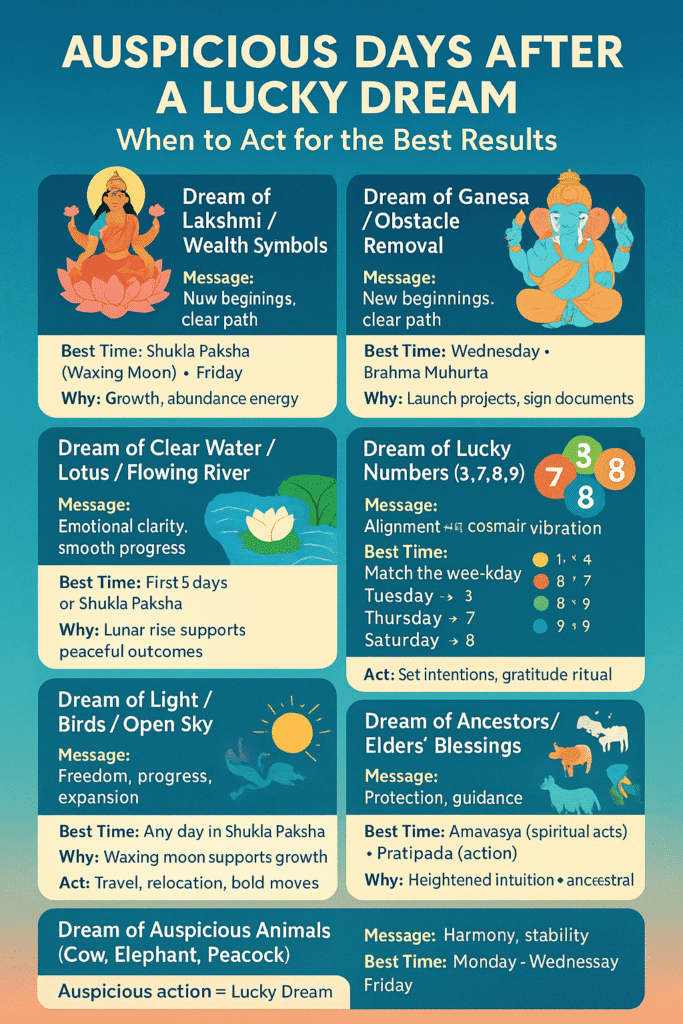
Auspicious Days and Timings to Act After a Lucky Dream
Once you’ve had a lucky or auspicious dream, the next question becomes how to choose the most favourable day to turn that symbolic message into action. Across Hindu astrology, Buddhist lunar traditions, Chinese calendars and general spiritual practice, timing is believed to enhance or weaken the effect of any new beginning. This is why many people search for auspicious days after a lucky dream or ask dream happened now what day to act when the dream feels significant.
Choosing the right moment is not superstition. These systems act like a timing compass: they help you align internal insight with external conditions so that opportunities unfold with less resistance.
Good Days vs Bad Days Chart
| Auspicious Days | Inauspicious Days |
|---|---|
| ✔️ Thursday | ✖️ Amavasya |
| ✔️ Friday | ✖️ Krishna Paksha (for growth) |
| ✔️ Wednesday (for beginnings) | ✖️ Chaturthi, Ashtami, Chaturdashi |
| ✔️ Shukla Paksha | ✖️ Eclipse days |
| ✔️ Pushya, Rohini, Uttarashada | |
| ✔️ Brahma Muhurta | |
| ✔️ Abhijit Muhurta |
If your dream involved luck or numbers, testing fortune during a waxing moon or Friday is a traditional practice — you may explore a low-risk try here.
Below is a full guide to the most supportive days, lunar periods and timing windows you can use after an auspicious dream.
1. Shukla Paksha (The Waxing Moon Phase)
This is one of the most universally recommended periods to act after a lucky dream. From the new moon to the full moon, the moon grows day by day, symbolising expansion, momentum and manifestation.
Why it matters:
• Supports growth-oriented decisions
• Aligns with increasing cosmic energy
• Encourages opportunities to mature faster
Actions suitable during Shukla Paksha:
• Starting projects
• Making financial decisions
• Testing luck or trying opportunities in low-risk scenarios
• Beginning new routines or habits
Many readers choose to take low-stakes chances during this period, especially if the dream involved money, rising water or symbols of abundance.
2. Auspicious Tithis for Acting After a Lucky Dream
Certain lunar days are traditionally considered more favourable for beginnings. While different regions have small variations, the following tithis consistently appear in classical sources as supportive:
• Dwitiya (2nd lunar day) – new beginnings with balance
• Tritiya (3rd) – creativity, prosperity, smooth momentum
• Panchami (5th) – clarity, problem-solving and emotional strength
• Dashami (10th) – success-oriented, strong forward movement
• Ekadashi (11th) – spiritual clarity and mental readiness
• Trayodashi (13th) – protection and favourable outcomes
• Purnima (full moon) – expansion and blessing energy
These tithis are often described by astrologers as the best time to act after dream messages involving wealth, recognition, movement or blessings.
3. Auspicious Nakshatras (Stars) That Amplify Lucky Dreams
Nakshatras add the most precise layer of timing. They represent lunar star clusters that influence the quality of each day.
The most favourable nakshatras to act under include:
Pushya
Widely considered the most auspicious for starting anything new. Connected to nourishment, protection and divine support.
Rohini
Linked to creativity, wealth, beauty and growth. Ideal for dreams involving prosperity or opportunities.
Uttara Phalguni
Excellent for commitments, long-term plans and structured progress.
Uttarashada
Known for stability, clarity and sustainable success.
Mrigashira
Good for exploration, learning, research and seeking clarity.
Anuradha
Brings loyalty, support and harmonious outcomes.
If your auspicious dream involved resources, blessings or breakthroughs, choosing one of these nakshatras becomes a strong choice for acting.
4. Brahma Muhurta (Early Morning Spiritual Window)
Dreams seen during Brahma Muhurta are already considered powerful, but acting during this time adds another layer of alignment.
This time window lasts approximately 96 minutes before sunrise. It represents sattvic energy (purity, clarity and peace), making it ideal for:
• Beginning a new intention
• Performing prayers, gratitude rituals or meditation
• Making early decisions
• Taking symbolic steps toward your dream message
If your dream hinted at opportunity, this period can serve as a small but meaningful start, especially when combined with Shukla Paksha or a favourable nakshatra.
5. Abhijit Muhurta (Midday Auspicious Period)
This is a highly favourable period around midday, traditionally associated with confident action and overcoming obstacles. Many use it for:
• Starting important tasks
• Sending applications or proposals
• Initiating financial steps
• Taking action after a dream of leadership, clarity or success
Even during challenging planetary conditions, Abhijit Muhurta remains a safe, reliable timing window.
6. Days of the Week Aligned With Dream Symbols
Different weekdays carry different planetary influences, helping determine when to act after lucky dream guidance.
• Monday – emotional clarity, family, peace
• Tuesday – breakthroughs, courage, assertive steps
• Wednesday – business, communication, planning
• Thursday – expansion, prosperity, wisdom (excellent for abundance dreams)
• Friday – wealth, beauty, harmony, Lakshmi energy
• Sunday – inner strength, beginnings, visibility
For example, after a dream involving money or gifts, many choose Friday as it aligns with Venus energy. After a dream of receiving blessings or divine support, Thursday becomes favourable.
7. When to Act Immediately After a Dream
Some dreams encourage fast action. This is especially common when:
• The dream occurred during Brahma Muhurta
• The symbols involved wealth, treasure, blessings, sunlight or open roads
• The emotional tone was extremely positive or serene
• The dream repeated more than once
In such cases, acting within the next 1–3 auspicious days is recommended. Many readers choose to test their luck or take small financial steps during these windows.
8. When to Wait Before Acting
Waiting may be beneficial when:
• The dream occurred during Amavasya
• You are currently in Krishna Paksha
• The symbol involved long journeys or gradual growth
• You feel unsure, overwhelmed or energetically drained
In these cases, delaying action until Shukla Paksha or a supportive tithi creates a stronger outcome.
9. Combining Multiple Favorable Factors
The strongest outcomes come from combining:
• A lucky dream
• A waxing moon
• A favourable tithi
• A supportive nakshatra
• A positive weekday
• A clean emotional state
Even using two or three of these together increases the favourable effect. This multi-layer timing approach is the core of the best time to act after dream Hindu belief and similar timing systems across cultures.
10. Acting on Lucky Dreams About Opportunity or Wealth
If the dream involved receiving money, winning something, finding treasure or symbols of abundance, many people prefer acting during:
• Shukla Paksha
• Friday or Thursday
• Pushya or Rohini nakshatra
If your dream felt connected to money, luck or opportunity, you may feel drawn to test your fortune on an auspicious day. Many readers prefer doing this during waxing moon days or early-morning muhurta hours. If you feel inspired, you can explore a trusted gaming platform and start with low-risk options through your preferred platform.
How Long Lucky Dreams Take to Manifest and Why Timing Matters
One of the most common questions people have after a positive or symbolic dream is how long after a dream will it come true. In traditional Hindu interpretation, dream manifestation time is not the same for every dream. It depends on the symbol, the moon phase, the hour of the night and your emotional state when you woke up. This is why dream timing astrology places so much importance on which part of the night the dream occurred and which lunar day follows.
Understanding when do dreams come true in Hinduism provides helpful guidance for interpreting lucky dream signs with more clarity. Classical texts and cultural teachings describe several timing clues that influence how quickly an auspicious dream becomes reality.
The Connection Between Lunar Cycles and Dream Outcomes
In many traditions, especially those rooted in Vedic understanding, lunar timing for dreams plays a major role. Dreams seen during Shukla Paksha are thought to manifest faster because the waxing moon supports growth, opportunity and positive outcomes. Dreams seen during Krishna Paksha can still be meaningful but may take longer to materialise or may require waiting for a more favourable lunar phase.
This is one of the main reasons people ask does dream timing matter. According to traditional belief, the answer is yes. Internal alignment combines with external timing to create the right environment for a dream’s message to unfold.
The Hour of the Dream and Its Manifestation Window
Dreams seen close to dawn are believed to come true sooner than dreams seen earlier in the night. Many Indian traditions say that dreams during Brahma Muhurta can unfold within days, while dreams before midnight may take weeks. This variation explains why dream manifestation time differs so widely between people and situations.
If a dream feels strongly positive, uplifting or symbolic, ask yourself what time it happened. This helps answer how long after a dream will it come true in a personalised way rather than relying on a single rule.
Emotional Tone as a Predictor of Dream Timing
Emotion is one of the strongest indicators of timing. Lucky dream signs such as flowing water, deities, sunlight, clear paths or receiving blessings usually come with a sense of peace, confidence or inner clarity. When the emotional tone is strong, the manifestation window is often shorter.
If the dream left you feeling calm, inspired or protected, you may expect events to unfold sooner, especially when paired with supportive lunar timing or favourable weekdays.
Acting at the Right Time After an Auspicious Dream
Knowing what to do after an auspicious dream is as important as interpreting it. Once you identify the main symbol, look at the timing layers around it:
• Waxing moon days
• Favourable tithis
• Supportive weekdays like Thursday or Friday
• Beneficial nakshatras
• Stable emotional readiness
These factors help you choose the right moment to turn the dream’s message into action. Even a small step taken during a favourable period can create momentum.
Why Timing and Action Work Together
In many cultural systems, dreams are not viewed as isolated events. They are considered messages that reflect your inner state and your readiness. Timing is the bridge between the inner message and the outer world. When you act at the right moment, the path often feels smoother, synchronicities appear more easily and the dream’s meaning becomes clearer.
This is why dream timing astrology and lunar timing for dreams remain important in many traditions today. They offer structure, clarity and grounding in moments when a dream feels powerful but mysterious.
If your dream felt unusually positive or symbolic, these principles can help you understand why it appeared, how long it may take to unfold and how you can align your actions with favourable timing to support its outcome.
How Many Days Until Dream Comes True?
| Dream Timing | Expected Results | Action Window |
|---|---|---|
| Early night | months | wait for Shukla Paksha |
| Midnight | weeks | next positive tithi |
| Dawn | 1–10 days | act soon |
| Brahma Muhurta | immediate | same week |
Test your luck here – maybe it’s the last ingredient to make your dream come true.
Examples of How People Acted After Lucky Dreams
Real-life examples make it easier to understand what to do after an auspicious dream and how dream timing astrology influences the outcome. Different people respond in different ways depending on the dream symbol, the lunar phase and the energy of the day. These stories also illustrate how long after a dream it will come true according to traditional beliefs, and why many cultures stress lunar timing for dreams, supportive weekdays and the idea that dream timing matters.
Here are three detailed examples showing how people aligned their actions with favourable timing and how their lucky dream signs unfolded.
Example 1: A Dream of a Goddess and Acting on a Friday
A woman in South India dreamed of Goddess Lakshmi offering her a lotus. Such dreams are considered powerful lucky dream signs in Hindu interpretation. She woke up during Brahma Muhurta, which is often linked with quicker dream manifestation time. Unsure what to do next, she researched when do dreams come true in Hinduism and found that Fridays are associated with Venus energy and Lakshmi blessings.
Instead of acting impulsively, she spent the week preparing her intention, performing a small gratitude ritual and choosing a supportive timing window. On Friday morning, during a favourable muhurta, she applied for a job promotion she had been hesitating about.
Within ten days she received positive news. According to dream timing astrology, dreams of divine beings often manifest faster when aligned with the correct weekday, which matched her experience. Her story shows that dream timing matters not only symbolically but also practically when paired with supportive action.
Example 2: A Dream of Flowing Water and Waiting Until Shukla Paksha
A man in Nepal dreamed of walking beside a wide, calm river with bright sunlight reflecting on the surface. Flowing, clean water is one of the strongest lucky dream signs across many cultures. The dream occurred during the waning moon, which made him wonder what to do after an auspicious dream when the lunar phase wasn’t ideal.
His grandmother advised him to wait until Shukla Paksha, the waxing moon, when lunar timing for dreams supports growth, opportunities and emotional stability. He patiently waited for the new lunar cycle before taking action on a long-term investment decision he had been considering.
He acted on Tritiya, a favourable tithi associated with smooth progress. Over the following months, the investment grew steadily. His experience aligns with traditional explanations of when do dreams come true in Hinduism, where dreams involving water often manifest after the moon begins to grow. It also shows how long after a dream it will come true may depend on lunar alignment and patience.
Example 3: A Dream of a Lucky Number and Using It on a Matching Weekday
A young woman dreamed of the repeating number 5 appearing on a glowing screen. She woke up feeling confident and searched for information about dream manifestation time and dream timing astrology. Since numbers can symbolize direction, opportunity or luck, she decided to align the number with timing.
She chose to act on Wednesday, the fifth day of the working week for her, and also linked Mercury energy (Wednesday’s ruling planet) with quick decisions and favourable outcomes. She used the number as a small opportunity signal and entered a low-risk game on a trusted platform, choosing 5 as her main number.
That same day she received a small but uplifting win. For her, it confirmed that does dream timing matter is more than a theoretical question. By matching the dream symbol with the right weekday and taking action during a calm mindstate, she experienced a quick result.
Example 4: A Repetitive Lucky Dream and Acting Quickly During the Next Auspicious Window
A young man repeatedly dreamed of the same symbol three nights in a row: a bright golden path leading toward sunrise. In traditional understanding, repetition is one of the strongest lucky dream signs because it indicates that the message is not random but urgent. He searched for guidance on when do dreams come true in Hinduism and discovered that repetitive dreams often mean the energy is already active and waiting for aligned action.
The dreams occurred during the early morning hours, which are associated with faster dream manifestation time. Unsure how long after a dream will it come true, he reviewed the symbolism: sunrise, golden light and a repeated path. These signs usually represent opportunity, direction and clarity.
Instead of waiting for weeks, he chose to act quickly. He selected the next favourable timing window: Shukla Paksha combined with a Thursday ruled by Jupiter, which is considered one of the strongest periods for progress in dream timing astrology. He took a concrete step by applying for a competitive training program he had been hesitant about for months.
Within just a few days, he received an unexpected invitation to an interview. For him, the series of repetitive dreams became proof that lunar timing for dreams and swift action during auspicious days truly amplify outcomes. It also reaffirmed that does dream timing matter is not only a traditional belief but a practical tool when a symbolic message appears more than once.
Practical Steps After a Lucky Dream
A lucky dream feels like a message. It leaves you with a sense of openness, clarity or opportunity. But the dream itself is only the beginning. What truly matters is how you respond to it. Across Hindu astrology, Buddhist practice, Islamic dream traditions and global folklore, people believe that the effect of an auspicious dream multiplies when the dreamer takes conscious steps during supportive timing windows. This is why many look for auspicious days after a lucky dream or wonder dream happened now what day to act.
Below are practical, grounded steps you can follow to honour the dream, prepare your energy and choose the most favourable moment to act.
1. Write Down the Dream Immediately
Memory fades quickly, and symbolic details become blurred. Writing down your dream within minutes or hours captures the exact images, feelings and events.
Include:
• What you saw
• Who appeared
• The emotions you felt
• Colours, numbers, directions or recurring symbols
• The time you woke up
Noting the time is especially important because it helps identify whether the dream occurred during Brahma Muhurta, midnight or early night, each of which influences when to act after lucky dream guidance.
2. Identify the Key Symbol and Its Tone
Lucky dreams often revolve around one main symbol: wealth, water, light, deities, open roads, thriving plants, gifts or helpful people. Ask yourself:
• What was the dominant symbol?
• Was the energy calm, joyful or uplifting?
• Did the dream feel like a beginning, a message or a blessing?
This helps determine the nature of the opportunity and the best time to act after dream inspiration.
For example:
• A dream of receiving money suggests quick windows like Shukla Paksha or Friday.
• A dream of planting seeds suggests slower, strategic timing like specific nakshatras or long-term planning days.
3. Match the Dream Type With the Timing Window
Use the dream’s symbolism to determine the ideal timing:
• Dreams involving movement or sunrise → act during waxing moon
• Dreams of wealth or blessing → act on Thursdays or Fridays
• Dreams involving deities → Pushya, Rohini or Uttarashada nakshatra
• Repetitive lucky dreams → act within the next 1–3 supportive days
This is one of the simplest ways to personalise auspicious days after a lucky dream.
4. Reflect on What the Dream Is Pointing Toward
Ask yourself: “What is this dream encouraging me to move toward?”
Lucky dreams often highlight areas like:
• Career or new opportunities
• Finances or investments
• Relationships and harmony
• Health or emotional clarity
• Travel or new phases in life
This reflection ensures your actions are intentional rather than impulsive.
5. Perform a Small Alignment Ritual
It does not need to be religious. The goal is to anchor the energy of the dream so it translates into real-life action during the right timing window.
Options include:
• Lighting a candle or diya in gratitude
• Sitting for a few minutes of quiet breathing
• Offering water or flowers to a deity or ancestor
• Saying a prayer or affirmation
• Listening to calming music to strengthen clarity
These rituals prepare the inner self before aligning with external timing.
6. Choose the Action Window According to Timing Rules
Match your dream with established timing guidelines:
• If your dream came at dawn, act within 1–10 days
• If it came during Shukla Paksha, begin as soon as you feel ready
• If it came during Krishna Paksha, wait for the moon to grow
• If it arrived on a Friday or Thursday, you may already be in a favourable window
This is a fundamental step in determining when to act after lucky dream messages.
7. Take a Symbolic First Step
You don’t need to make a huge move immediately. A small symbolic gesture can begin the flow of opportunities while you wait for the most auspicious day.
Examples:
• Sending a message
• Starting a draft of an application
• Ordering supplies or tools
• Cleaning your space
• Creating a plan or list
Symbolic first steps create momentum and signal readiness to the mind and environment.
8. Use the Right Day to Begin Concrete Action
Once the favourable timing window arrives, take the actual step:
• Apply for something
• Start a new routine
• Make a financial decision
• Schedule a plan
• Follow the opportunity the dream hinted at
Many people use these timing windows to test their fortune in small ways. If your dream involved abundance symbols, you may choose to explore a low-risk opportunity or use the day to try your luck on a trusted casino platform. Acting during auspicious timing can help you feel aligned and courageous when taking such steps.
9. Reaffirm the Intention After Acting
After you act, anchor the experience by reaffirming your intention. This can be something simple like:
• “I am aligned with positive timing.”
• “I welcome favourable results.”
This reinforces the psychological and spiritual clarity the dream provided.
10. Track Outcomes and Patterns
By observing how your actions unfold after following auspicious timing, you build your own library of dream patterns. After a few months, you may notice:
• Certain symbols appear before successful steps
• Some days or nakshatras work especially well for you
• Particular lunar phases amplify results
This helps you refine your sense of when to act after lucky dream messages in a personal and practical way.
How Fast Lucky Dreams Manifest: Overview
Dream manifestation time depends on when the dream happened, the symbol, the lunar phase, and your emotional clarity when you woke up. In Hindu and spiritual traditions, dreams seen at dawn or during Brahma Muhurta are believed to manifest fastest, especially when aligned with auspicious lunar days or supportive nakshatras.
Quick Answer
Dreams at dawn or around 4 AM manifest the fastest, often within days, while dreams involving slow-growth symbols may manifest over weeks or months depending on timing and action.
Fastest Manifesting Dreams Ranked
| Dream Type | Manifestation Speed | Typical Timeframe | Why It Manifests Fast | Ideal Timing to Act |
|---|---|---|---|---|
| Dreams at Brahma Muhurta (around 4–5:30 AM) | Very fast | Same week | Mind is sattvic, intuition clear, high spiritual influence | Within 1–3 auspicious days |
| Dreams at Dawn (near sunrise) | Fast | 1–10 days | Traditionally believed to reflect divine impressions | During Shukla Paksha or next favourable tithi |
| Dreams of Deities or Saints | Fast | Days to one week | Considered direct blessings or approvals | Thursday, Friday, Pushya or Rohini |
| Dreams of Clear Water, Flowing River or Clean Rain | Fast | Days to weeks | Symbol of emotional clarity and smooth momentum | Early Shukla Paksha, Tritiya or Panchami |
| Dreams of Light, Lamps, Sunrise or Fire | Medium-fast | 3–14 days | Symbol of illumination, new beginnings and clarity | Sunrise hours or next waxing moon day |
| Dreams of Birds, Flying, Open Sky | Medium | 1–3 weeks | Associated with progress and movement | Any day of Shukla Paksha |
| Dreams of Receiving Gifts, Money, Coins or Treasure | Medium-fast | Days to two weeks | Symbol of incoming opportunity or support | Friday or Thursday, favourable nakshatras |
| Repeating Lucky Symbols (numbers, water, deities, sunrise) | Fast | Very soon after repetition | Repetition indicates readiness and alignment | Next 1–3 favourable days |
| Dreams of Horses, Elephants, Peacock | Medium | 2–4 weeks | Symbols of power, support and progress | Wednesday, Friday, waxing moon |
| Dreams of Plants, Seeds or Growth | Slow | Weeks to months | Symbol of long-term development | Begin during waxing moon or nurturing nakshatras |
If your dream involved money, numbers or flowing water, many traditions say these symbols favor small fortune-testing actions during waxing moon days. If you feel aligned, explore low-risk opportunities through our recommended partners.
Why Some Lucky Dreams Manifest Slowly
Not all auspicious dreams come true immediately. Even if the symbol is positive, several factors can slow the manifestation process. Understanding these delays helps you choose the right moment to act and avoid misinterpreting a dream’s timing.
1. The Symbol Itself Reflects Gradual Growth
Dreams about plants, seeds, mountains, long journeys or construction projects naturally represent long development cycles.
These dreams encourage patience rather than immediate action.
Signs of slow-growth dreams:
• Seeds sprouting
• Building houses or structures
• Traveling long distances
• Climbing or walking uphill
These symbols often activate over months, not days.
2. Dream Occurred During Krishna Paksha
Waning moon days weaken external momentum.
Even a lucky dream may take longer to manifest if it happened while the moon was decreasing.
Best approach:
Wait for Shukla Paksha before acting.
3. Emotional Confusion After the Dream
If you woke up feeling stressed, uncertain or overwhelmed, the emotional signal may block the clarity of the dream.
Dreams manifest fastest when the emotional tone is calm, inspired or confident.
4. You Acted During an Unfavourable Timing Window
Acting on the wrong day can slow results, even when the dream is positive.
Delaying factors include:
• Amavasya
• Eclipse periods
• Ashtami, Chaturthi, Chaturdashi
• Conflicting weekdays (example: acting on Saturday for a Venus-type dream)
5. Real-Life Conditions Are Not Ready Yet
Sometimes the dream shows future potential, but your external environment hasn’t aligned.
Examples:
• Financial instability
• Delayed opportunities
• Other people involved needing time
• Karmic timing not yet complete
These dreams symbolize future blessings that unfold when conditions improve.
6. You Haven’t Taken Any Step Yet
Dreams rarely manifest without action.
Even a small symbolic step—writing intentions, starting a plan, making a call—helps activate the timeline.
7. The Dream Was a Blessing, Not a Timeline
Some dreams give reassurance, not immediate events.
They comfort you, protect you or confirm you’re on the right path, but they don’t always predict instant change.
Why Some Lucky Dreams Don’t Come True
Even when a dream carries clear lucky dream signs such as flowing water, blessings, sunlight, gifts or divine presence, the outcome does not always appear in waking life as expected. This does not mean the dream was wrong. Instead, many traditions teach that timing, emotional readiness and external circumstances all influence dream manifestation time. Understanding why some dreams unfold quickly while others never materialise helps you work with dream timing astrology more effectively and decide what to do after an auspicious dream with clarity instead of confusion.
Quick Answer
Some lucky dreams don’t come true because the timing wasn’t supportive, the lunar phase slowed manifestation, the symbol was misunderstood, or no action was taken. Dream timing matters as much as the dream itself, and manifestation depends on aligning your steps with favourable lunar days, emotional clarity and real-world readiness.
Lucky dreams may fail to manifest when action is taken at the wrong time, such as during the waning moon or inauspicious tithis, or when the dream’s message was symbolic rather than predictive. Traditional teachings say that dreams manifest only when the symbol, lunar timing and emotional state work together, so choosing the right moment to act can greatly influence the outcome.
Below are the most common reasons why an auspicious dream may not come true, even when the symbols were positive.
1. Acting at the Wrong Time
In many cultures, especially in Hindu astrology, timing is as important as the dream itself. If action was taken during an unfavourable timing window, the dream’s potential weakens.
Dreams may not manifest if you acted during:
• Krisha Paksha for growth-related intentions
• Amavasya, when energy is inward
• Inauspicious tithis such as Ashtami or Chaturthi
• Eclipse days
• A weekday that conflicts with the dream symbol
This is one of the key answers to when do dreams come true in Hinduism: only when action aligns with both the symbol and the timing.
2. The Lunar Phase Did Not Support the Symbol
Lunar timing for dreams plays a central role across Hindu, Tibetan, Chinese and indigenous traditions. The moon represents movement, emotion and momentum. Even the strongest dream may fade if acted upon during a contracting lunar phase.
For example:
• A wealth dream acted on during the waning moon may stagnate
• A travel dream acted on during a low-energy phase may cause delays
• A dream of new beginnings acted on during the dark moon may weaken
When people wonder how long after a dream will it come true, the lunar phase is often the missing piece.
3. Emotional State Not Aligned With the Dream
A dream may bring a message, but your emotional state after waking influences how you respond to it.
If you feel anxious, heavy, confused or overwhelmed after a dream, the emotional static can block intuition and slow manifestation.
Dreams manifest more easily when:
• You feel peaceful
• Your mind is stable
• You have clarity of intention
• You trust the process
Even lucky dream signs need emotional alignment to unfold smoothly.
4. No Action Was Taken
Even the most auspicious symbol cannot materialise without a real-world action.
Dreams lean toward potential, but you activate that potential through steps—large or small.
Common reasons people don’t act:
• Fear of change
• Waiting too long
• Not recognising the symbol
• Doubting the dream’s meaning
• Not knowing what to do after an auspicious dream
Dream timing astrology explains that ignoring the dream’s timing window weakens the energy over time.
5. Symbolic Dreams vs Predictive Dreams
Some dreams are symbolic rather than literal.
A dream may bless you, reassure you or indicate inner healing—not predict an external event. This type of dream provides guidance, not a timeline.
Examples:
• Dream of a deity giving comfort
• Dream of light without context
• Dream of a calm lake
• Dream of ancestors smiling
These dreams support your inner world, but they may not produce external results unless you take action aligned with their message.
6. External Circumstances Were Not Ready
Some dreams reflect what could happen, not what will happen immediately.
If your environment or the people involved were not aligned, the dream’s outcome may shift or postpone.
Reasons include:
• Financial timing not right
• Opportunities still forming
• Another person involved not ready
• Environmental delays
• Karmic timing not complete
This is why dream manifestation time can vary significantly from one person to another.
7. The Dream Symbol Was Misinterpreted
Sometimes the dream was auspicious, but the interpretation was literal when it should have been symbolic.
Examples:
• Money in a dream may mean emotional value, not financial gain
• Water may indicate healing, not opportunity
• Dogs or horses may represent loyalty or movement, not events
• A road may represent learning, not physical travel
If the symbol was misinterpreted, the action may have been misaligned, causing the manifestation to weaken.
8. The Dream Was a Future Message, Not a Present One
Many auspicious dreams indicate future potential rather than immediate change.
Signs of future-oriented dreams:
• Slow-growth symbols like plants
• Journeys that take time
• Construction of buildings
• Meeting a guide who points into distance
These dreams often require waiting for multiple timing layers to align.
9. Repetition Was Needed but Ignored
When a dream repeats, the message strengthens.
When a dream appears only once, especially during an unfavourable lunar window, the energy may not be strong enough to manifest.
If repetition was ignored, the timing window may have passed before action was taken.
10. The Dream Was a Blessing but Not a Prediction
Some dreams carry blessings meant to encourage, protect or comfort you—not create external changes.
Examples:
• A deity smiling
• Receiving a flower
• Being hugged by a loved one
• Seeing radiant light
These dreams uplift the spirit but may not correspond to specific events.
What to Avoid or Postpone
Even when a dream feels deeply promising, not every day or moment is ideal for taking action. Many traditional systems emphasise that knowing what to avoid is just as important as identifying auspicious days after a lucky dream. Acting at the wrong time can weaken momentum, delay results or create unnecessary resistance. Understanding which periods are less favourable helps you decide when to act after lucky dream guidance with clarity and confidence.
Below are the main conditions and timing windows that are best avoided or postponed before you move forward.
1. Avoid Acting During Amavasya (New Moon) Unless the Dream Was Spiritual
Although the new moon is a powerful spiritual period, it is rarely the best day to begin practical or material activities. Energy levels are low, clarity is reduced and the lunar influence favours introspection rather than progress.
Exceptions include:
• Dreams involving ancestors
• Dreams of spiritual guidance
• Dreams involving inner healing
If your dream was connected to wealth, opportunity or outward growth, it’s often better to wait for Shukla Paksha before acting. This is one of the first things people check when asking dream happened now what day to act.
2. Avoid Acting During Inauspicious Tithis
Certain tithis are traditionally considered less favourable for new beginnings, especially:
• Chaturthi (4th lunar day) – tends to bring obstacles
• Ashtami (8th) – linked to intensity and emotional turbulence
• Navami (9th) – transformation-oriented but unstable
• Chaturdashi (14th) – high energy, but too volatile for clean beginnings
Your dream may have been lucky, but acting on these days could introduce unnecessary challenges.
3. Postpone Decisions During Eclipse Periods
Solar and lunar eclipses are considered moments of energetic inversion or disruption in many traditions. Dreams during eclipse nights can be meaningful, but actions taken immediately after are often discouraged.
Reasons include:
• Confusion in emotional clarity
• Temporary imbalance in lunar and solar influence
• Higher risk of miscalculating opportunities
If your dream occurred near an eclipse, wait several days for the energy to stabilise.
4. Avoid Acting During Krishna Paksha (Waning Moon) for Growth-Related Dreams
The waning moon is ideal for releasing, simplifying or ending things, but it is not ideal for dreams involving:
• Wealth
• Career opportunities
• New relationships
• Abundance
• Expansion
Lucky dreams that point toward growth usually manifest better during the waxing moon. This is why many traditions advise waiting rather than acting immediately when the moon is decreasing.
5. Avoid Acting When You Feel Emotionally Unsettled
Even if timing is astrologically supportive, your internal state matters. Postpone important actions if you feel:
• Anxious
• Confused
• Pressured
• Mentally distracted
• Emotionally drained
Dreams require clarity and receptivity. Acting while unsettled may distort the message or weaken the opportunity.
6. Postpone When the Dream Symbol Suggests Gradual Growth
Not every lucky dream requires fast action. Certain symbols indicate that patience is part of the process.
Postpone action if your dream involved:
• Seed planting
• Slow-growing plants
• Long journeys
• Construction
• Mountains
• Busy marketplaces
These dreams often represent progress that unfolds step by step. Waiting for precise timing windows such as supportive nakshatras or Thursdays/Fridays may be more beneficial.
7. Avoid Acting During Retrograde-Inspired Uncertainty (if you follow astrology)
Although this is optional and depends on personal belief, many people avoid major steps during Mercury retrograde or Venus retrograde if the dream involved:
• Contracts or agreements
• Relationships or emotional connections
• Communication-heavy plans
Your dream may still be auspicious, but the external environment may not support immediate action. Waiting for clean planetary motion might help the dream’s promise unfold more smoothly.
8. Postpone When Your Dream Was Strong but You Lack a Clear Action
Sometimes you receive a powerful lucky dream, but you don’t yet know what it points toward. In this case, acting too quickly can lead you in the wrong direction.
Instead:
• Wait for clarity
• Review your notes
• Observe if more dreams follow
• Choose timing based on the symbols’ deeper meaning
It’s better to postpone than to act impulsively.
9. Avoid Acting When External Conditions Clash With the Dream’s Message
If your dream hinted at growth or opportunity, but your real-life environment is currently unstable, wait for both the timing and context to align.
Examples:
• Financial uncertainty
• Relationship tension
• Health-related exhaustion
• Major life stress
The dream may still be positive, but the moment may not be ideal yet.
10. Avoid High-Risk Actions Until Timing Supports You
Even if your dream encouraged taking a chance, the most favourable timing ensures that small risks remain manageable. Acting during unstable days may dilute the potential.
If your intention involves testing luck, low-stakes decisions, or symbolic opportunities, wait until:
• Shukla Paksha
• Thursday or Friday
• A supportive nakshatra
• A calm emotional state
This way, your actions align with the best time to act after dream guidance, and the positive momentum of the dream is preserved.
Psychological and Spiritual Insight
Dreams often act as bridges between the conscious and subconscious mind. When a dream feels lucky or auspicious, it usually mirrors a moment when your inner and outer worlds are beginning to align. From a psychological point of view, such dreams emerge when the mind senses readiness for opportunity long before logic confirms it. They symbolize confidence, emotional clarity, and a quiet willingness to move forward.
Spiritually, a lucky dream is not random — it’s the universe whispering that certain paths are opening. According to Hindu philosophy, dreams occur when karma, intention, and divine timing converge. Seeing favorable symbols, deities, or auspicious scenes suggests that your personal vibration has risen to match higher possibilities. The dream therefore becomes an energetic invitation to act, but only when timing and awareness are in harmony.
Psychologists might describe this as a moment of heightened intuition — the unconscious collecting subtle patterns from daily life and presenting them in symbolic form. In Vedic thought, it’s the same principle expressed through daiva (divine will). The dream gives you a glimpse of potential, but the outcome depends on how mindfully you follow it.
Acting too quickly can scatter this subtle energy; waiting too long can let it fade. That is why ancient teachings emphasize muhurta — sacred timing — as a way to anchor inner inspiration in the material world. When you align action with an auspicious day, you synchronize your emotional readiness with cosmic rhythm. It’s less about superstition and more about resonance: your mind, emotions, and universal cycles moving together in one flow.
A helpful practice is to notice how your body and intuition respond after the dream. Do you feel calm and certain, or restless and unsure? A centered feeling often means the time is near; hesitation can signal the need to wait for the next favourable day. Trusting these cues is part of developing inner timing — the ability to sense when destiny and effort meet.
Ultimately, both psychology and spirituality point to the same truth: lucky dreams appear when your subconscious and the universe agree on a direction. Acting during an auspicious time simply amplifies that harmony, transforming a fleeting vision into meaningful progress
Summary Table – Auspicious Days After a Lucky Dream
| Type of Lucky Dream | Core Message | Best Time to Act | Why This Timing Matters | Suggested Action |
|---|---|---|---|---|
| Dream of Goddess Lakshmi / wealth symbols | Abundance, financial blessing | Shukla Paksha (waxing moon) or Friday | Energy of growth, prosperity, and feminine blessing | Begin savings, investments, or career-related moves |
| Dream of Ganesha / obstacle removal | New beginnings, clearing blocks | Wednesday or early morning Brahma Muhurta | Ganesha governs intellect and new starts | Start new projects, sign documents, send proposals |
| Dream of clear water, flowing river, lotus | Emotional clarity, good fortune | First 5 days of Shukla Paksha | Rising lunar energy supports smooth outcomes | Begin personal changes or relationship decisions |
| Dream of receiving gifts, money, blessings | Unexpected opportunities, support | Next auspicious tithi (Dwitiya, Tritiya, Panchami, Saptami) | These tithis amplify positive outcomes | Make purchases, apply for jobs, send important messages |
| Dream of lucky numbers (3, 7, 8, 9) | Alignment with cosmic cycles | On the matching weekday (Tuesday = 3, Thursday = 7, Saturday = 8, Sunday = 9) | Resonance between number vibration and weekday energy | Set intentions, perform gratitude ritual, take decisive step |
| Dream of light, lamp, sunrise, golden color | Spiritual approval, success | During sunrise hours for next 3 days | Sun energy enhances clarity and auspiciousness | Start spiritual, educational, or wellbeing-related goals |
| Dream of birds, flying, open skies | Freedom, progress, new opportunities | Any day during Shukla Paksha | Waxing moon supports expansion and upward movement | Plan travel, relocate, or take courageous actions |
| Dream of victory, celebration, winning | High momentum, karmic support | Chaturthi, Panchami, Ashtami, Ekadashi | These days favor breakthroughs and positive results | Start competitive tasks, submit applications, make bold decisions |
| Dream of ancestors or blessings from elders | Protection, guidance, karmic release | Amavasya (for spiritual acts) or Pratipada (next day for action) | Ancestral blessings heighten intuition and protection | Begin healing rituals, family decisions, or legacy-related tasks |
| Dream of animals considered auspicious (cow, elephant, peacock) | Harmony, stability, good luck | Monday, Wednesday, or Friday | These weekdays strengthen grounding and positive energy | Begin long-term plans, health changes, or family decisions |
Key Takeaways
- Lucky dreams are signs of inner readiness and cosmic alignment — they appear when your intuition and the universe point toward a new direction.
- Acting immediately isn’t always ideal; Hindu belief emphasizes choosing the right day and right moment (muhūrta) to strengthen the positive outcome of a dream.
- Favourable timings such as Shukla Paksha, specific tithis, and auspicious weekdays amplify the blessing and momentum behind an auspicious dream.
- Each dream type suggests a different action window — wealth symbols favour Fridays and waxing moon days, while Ganesha dreams favour Wednesdays and early morning hours.
- Aligning your dream message with the correct timing creates a powerful combination of clarity, intuition, and cosmic support.
- Listening to your emotional state after the dream helps you recognise whether to act quickly or wait for the next auspicious day.
- Combining inner intuition with outer timing allows you to turn a dream’s blessing into meaningful action and long-lasting results.
FAQ: Auspicious Days After a Lucky Dream
What should I do after having a lucky dream?
Write down the details as soon as you wake up, note the timing of the dream, and identify the main symbol. After that, choose a favourable timing window such as Shukla Paksha, a supportive tithi or an auspicious weekday. Many people align their decisions with auspicious days after a lucky dream to strengthen the dream’s potential.
When is the best time to act after a lucky dream?
The waxing moon, supportive tithis like Dwitiya, Tritiya, Panchami or Dashami, and weekdays such as Thursday or Friday are traditionally favourable. The best time to act after dream guidance depends on the dream’s symbolism and the lunar phase.
How many days after a dream does it manifest?
Traditional Hindu interpretations suggest that dreams closer to dawn manifest in 1–10 days, while midnight dreams may take several weeks. Early-night dreams may take longer unless supported by strong symbols. The timing also depends on whether you act during supportive lunar days.
I had a lucky dream at dawn. What does it mean and when should I act?
Dreams at dawn are considered highly potent and often linked to quick results. Acting during the next 1–10 auspicious days is recommended, especially during a waxing moon or supportive nakshatra.
Do dreams at 4am come true?
Dreams around 4 AM fall within Brahma Muhurta, one of the most spiritually charged times of the day. Many traditional sources say these dreams are more likely to come true because the mind is calm and receptive. If the dream felt auspicious, this timing supports acting sooner.
Do dreams come true faster during Brahma Muhurta?
Yes. Dreams during Brahma Muhurta are often considered the most meaningful and may manifest quickly if aligned with favourable timing.
Do dreams on full moon come true faster?
Full moon dreams are associated with heightened intuition and expanded emotional energy. Many traditions believe that dreams on a full moon can manifest faster because the lunar energy supports visibility, clarity and growth.
Is it good to act immediately after a lucky dream?
Immediate action is ideal only if the timing is supportive and the dream carried strong positive energy. Otherwise, waiting for the next favourable tithi, weekday or lunar phase can lead to better outcomes.
Which dreams should you act on immediately?
Dreams involving light, blessings, wealth, treasure, clean flowing water, sunrise travel, or direct guidance from a deity or ancestor often encourage quick action. Repetitive dreams with the same symbol may also signal that the window is already open.
Which dreams are warnings vs blessings?
Blessing dreams feel peaceful, bright or encouraging and may show symbols like light, gifts, flowing water, deities or helpful figures. Warning dreams often include frustration, being blocked, losing something important, storms, broken objects or confusing crossroads. If the dream felt heavy or unsettling, it may not be the right moment to act. Instead, observe patterns or wait for clarity.
Are certain days of the week better for acting on lucky dreams?
Thursday and Friday are especially supportive, while Monday and Sunday help with emotional clarity and new beginnings. Choosing the day according to planetary influence can boost results.
Should I act on a lucky dream during a waning moon?
It is usually better to wait for the waxing moon, especially for dreams linked to growth, abundance or new opportunities.
Can I ignore timing and still benefit from a lucky dream?
Yes, but timing can amplify the dream’s effect. Acting during auspicious days after a lucky dream helps align internal insight with external energy.
What if my lucky dream happened during an eclipse?
Dreams during eclipses can be meaningful but acting immediately is not recommended. Eclipse periods bring emotional instability, so waiting several days is considered beneficial.
Do repetitive lucky dreams mean I should act faster?
Yes. Repeated symbolic dreams usually indicate that the message is stronger and that action taken during the next favourable window may be especially effective.
Should I take financial steps after a lucky dream?
If the dream involved money, treasure, blessings or clean water, acting during a favourable lunar day or weekday may be supportive. Some people take small, low-risk steps or test their luck during these periods.
Does the emotional feeling in the dream matter?
Absolutely. Dreams that feel peaceful, uplifting or energising are considered more auspicious. Even simple symbols become meaningful when accompanied by positive emotion.
Conclusion
A lucky dream is never just a dream. It arrives at a moment when your inner world is already shifting, and the universe mirrors that change through symbols, omens, and subtle messages. But even the most auspicious dream reveals only part of the path; the rest depends on how you align your actions with the right moment.
In Hindu and spiritual tradition, timing is not superstition — it is resonance. Acting during Shukla Paksha, on favourable tithis, or at auspicious hours like Brahma Muhurta amplifies the positive energy already present in your dream. These windows of time help your intention take root in a supportive environment, turning insight into progress with far less resistance.
Still, the ultimate guidance comes from within. Notice how you feel after the dream: calm, confident, and centred often means the universe is clearing the way; restlessness suggests waiting for the next auspicious day. Dream messages work best when intuition and timing move together.
A lucky dream is a blessing, but a wisely chosen moment transforms it into opportunity. When you honour both the dream and the timing, you step into flow — a space where decisions feel lighter, paths open naturally, and life responds with surprising ease. Whenever in doubt, return to the dream, the timing, and your intuition. These three signals will never mislead you.
If you feel inclined to test your luck and find the ways it might bring you fortune – try out the best gaming platforms available from our partners.